Recovery isn’t just about abstaining — it’s about retraining. If you’ve ever asked, “Why can’t I just stop?”, the answer lives in your brain’s wiring. The science of rewiring the brain in recovery shows us that change isn’t about willpower alone — it’s about neuroplasticity, the brain’s ability to rewire itself with practice, repetition, and structure.
The Brain Learns What You Practice — Even When It’s Harmful
Addiction isn’t a moral failure. It’s a form of learning. The brain learns what you do repeatedly. If you’ve used substances or behaviors to manage stress, trauma, or discomfort — your brain wires itself around that. Recovery is the process of unlearning those pathways and building new, usable ones.
“Your brain isn’t broken. It just got really good at the old route.”
The Bike Analogy: Why “Just Stop” Doesn’t Work
As TPBH Program Visionary Tanner explains, “Imagine trying to forget how to ride a bike. You can’t.” That’s the same frustration people face when told to “just stop drinking.” These behaviors aren’t simply habits — they’re stored in the brain’s automated systems, tied deeply to emotional responses, muscle memory, and environmental cues. Recovery isn’t about erasing the path — it’s about building a new one through repeated, intentional choices that rewire the brain over time.
Imagine if someone asked you to forget to ride a bike. That’s what happens when someone says, “just stop drinking.” The behavior is stored, automated, and tied to your emotions and environment.
Tanner Grimsley, L.A.C. & Program Visionary at Turning Point Behavioral Health
How the Brain Builds a New Path
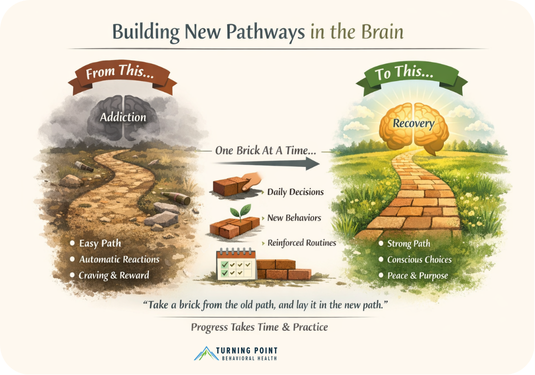
We don’t erase the old path. We build a new one.
Every healthy decision you make in recovery is like laying a new brick on a different trail.
Each choice is a brick. Over time, that path becomes more walkable than the old one.
Why Real Change Takes More Than 30 Days
Many people begin their recovery journey in short-term programs — but real change takes time. At TPBH, we understand that healing the brain and building new behavioral pathways requires more than 30 days.
Without consistent repetition, it’s easy to find yourself at the same fork in the road. Our extended care model, ranging from 60 to 180 days, gives individuals the structure, skills, and support to lay down a truly walkable path forward.
Not sure if you or a loved one needs treatment? You can take a free, anonymous screening through the Treatment Connection Assessment Tool to explore your risk level and next steps.
Disclaimer: Turning Point Behavioral Health is not affiliated with TreatmentConnection.com and does not collect or view your results. This tool is offered as a public resource only.
Structure Heals: What Actually Helps Rewire the Brain
Recovery isn’t passive. It requires input. The more you do certain things, the more your brain automates them.
What we Do
Why It Matters in Recovery
Cognitive Therapy
Shifts distorted thinking patterns
Daily Routine
Creates reliable, regulated brain inputs
Community & Connection
Reduces stress and reactivates healthy pathways
Skills-Based Milestones
Rebuilds identity, purpose, and long-term memory
Why Some Days Still Feel Hard
Even when you’re doing well, the old path may call. Especially under stress.
“If you don’t have a usable new path yet, the brain will default back — even when you don’t want to.”
Relapse doesn’t mean failure — it just means the new path needs more reinforcement.
What About Cravings, Triggers, or Emotional Flooding?
These are conditioned responses — your brain reacting out of habit. The solution isn’t shame. It’s practice.
Pause instead of react
Breathe before responding
Create a new micro-choice in the moment
One small choice can lay a brick that matters.
Internal vs External Success
Often, people rush to rebuild external stability — jobs, relationships, money — without reinforcing their brain’s internal wiring.
But success that skips over recovery becomes fragile. As research demonstrates, young adults with substance use disorders benefit most from integrated, extended treatments that address both neuro-cognitive and behavioral rewiring over time (Hadland et al., 2021). That’s why TPBH’s 60–180 day program focuses not just on abstinence, but on building sustainable internal change — through daily structure, therapeutic conditioning, and long-term milestones that promote true resilience.
FAQs
How does the brain change during addiction recovery?
Recovery creates new neural pathways by repeatedly choosing healthy behaviors, emotional regulation, and structure. Over time, the brain favors these healthier responses.
Can therapy really rewire the brain?
Yes. Cognitive Behavioral Therapy (CBT) and structured care reshape how the brain thinks, reacts, and solves problems.
How long does it take for the brain to change?
Initial healing begins within weeks, but stable pathways form between 60–180 days of structured, intentional input.
Why do I relapse even when I want to change?
Because motivation isn’t enough. Without new neural pathways, your brain defaults to what it knows. It’s about building something usable — not just avoiding the old.
Your brain is capable of change. With structure, repetition, and support — you are literally rebuilding the way your brain thinks, feels, and responds.
Need Help Getting Started?
If you or someone you love is ready for meaningful, lasting recovery — we’re here.
* This blog is for educational purposes only and is not a substitute for professional medical advice, diagnosis, or treatment. If you or someone you know is struggling with addiction or mental health challenges, support is available. Turning Point Behavioral Health provides compassionate, person-centered care to help individuals begin or continue their recovery journey. To speak with our team, please contact us directly. 605-636-8686
Citations:
Hadland SE, Yule AM, Levy SJ, Hallett E, Silverstein M, Bagley SM. Evidence-Based Treatment of Young Adults With Substance Use Disorders. Pediatrics. 2021 Jan;147(Suppl 2):S204-S214. doi: 10.1542/peds.2020-023523D